Move over, crypto and Stablecoin. The next big thing in deposits is tokenized deposits. Not only are they more secure, but they can be deposited and withdrawn from anywhere to anywhere, a feature that geographically limited banks can turn to their advantage.
As he’s done in the past, the venerable Gene Ludwig figured this out at the onset of the trend and has built a vehicle for non-universal banks to be able to offer digitized deposits by sharing the infrastructure cost. Just like he did with reciprocal CDs, which eventually turned into IntraFi and fetched $1.5B when sold, he is doing the same with CARI. The Cari network is positioned as the digital currency solution for mid-sized banks. It is a tokenized network that leverages capital contributions from many banks to jointly fund the development of a tokenized deposits platform using Blockchain technology. It utilizes a similar funding concept to Ludwig’s previous efforts ( such as Canopy Fund) to offer synthetic scale solutions for non-mega banks.
The real challenge for all banks but the biggest is the ability to build an efficient, customer friendly mechanism to offer the product. Ludwig, with the help of over 50 banks, is putting together the funding for a shared platform.
Ludwig’s solution offers insured tokenized deposits with 24/7 Blockchain settlement. His value proposition is based on leveraging Blockchain technology coupled with the reliability and trust of the banking industry. While Stablecoins offer instant settlement and 24/7 availability, Ludwig’s platform adds FDIC insurance, cash-equivalent accounting treatment and a seamless conversion with Fiat bank ledgers. The latter is important because it allows for the transfer of USD deposits underlying the token in conjunction with the digital rail.
In addition, Fireblocks, a digital asset infrastructure provider that supports custody, wallet infrastructure, governance, and connectivity across tokenized deposit, stablecoin, and tokenized asset networks.
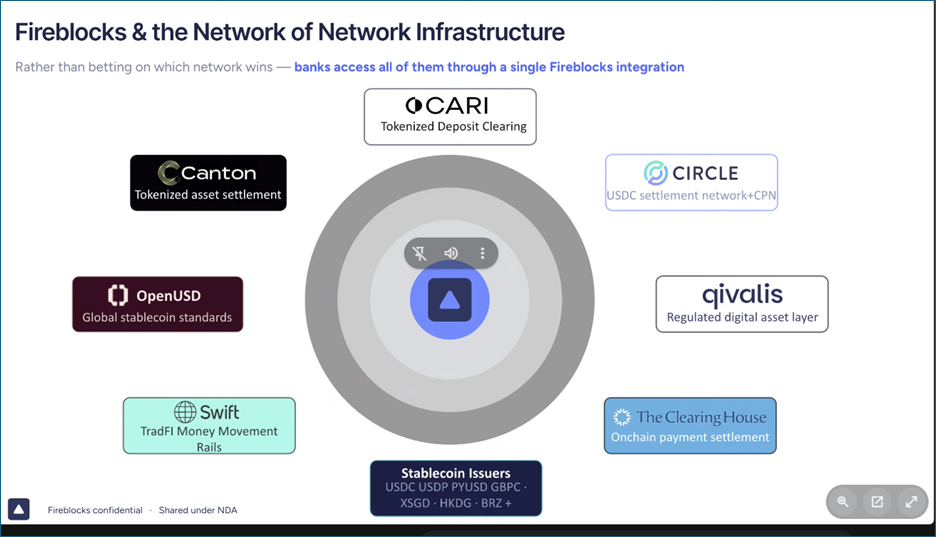
Fireblocks is positioning itself as a facilitator of tokenized deposits and payments infrastructure. They plan to serve as the operational layer for the Cari Network and are building connectivity across multiple tokenized deposit and stablecoin networks. Their view is that banks will ultimately need access to multiple settlement networks rather than betting on a single rail. I share that view, although history tells us that in matters of this magnitude, one network prevails as the dominant vehicle (Visa, MasterCard, Discover and all the rest are a good example).
Fireblocks is also working toward SWIFT integration, tokenized asset networks, and broader digital asset infrastructure. The slide below, produced by them, illustrates how they are positioning their platform as a connectivity layer across multiple networks.