
Per-token prices are falling, yet $31.6 trillion of global AI infrastructure investment is projected through 2050, the fastest scaling technological cycle in enterprise history. The gap between cheaper tokens and bigger bills is the cost few budgets planned for, and it is separating the companies that can scale AI from the ones that cannot.
For two years, many companies measured AI progress by how much of it they used and called it tokenmaxxing. They handed engineers the top models, treated heavy usage as momentum and ranked teams on how many tokens they burned. That model stopped working when employees ran up token usage on trivial or low-value tasks, and they moved to tracking useful output (e.g., features shipped) instead.
The question is no longer whether AI creates value. It is whether that value can be delivered profitably at enterprise scale.
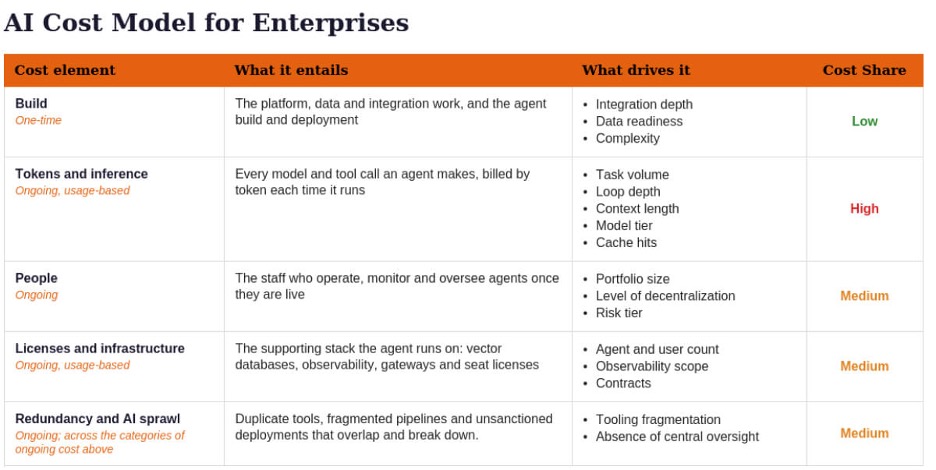
The answer is to manage what each AI outcome actually costs—its total cost of ownership, which runs well beyond the model bill. An agent’s cost usually has five parts: the one-time build, ongoing tokens and inference, the people who operate and oversee it, licenses and infrastructure, and the cost of redundancy and AI sprawl that accumulates off the books. Out of these, tokens and redundancy have the largest swing.
What Drives the Token Bill
Three forces drive the token bill. Volume per task keeps climbing as agents reason more deeply, outpacing the falling price per token. Unit prices are resetting upward toward real cost. Model choice adds a third swing factor. According to PwC benchmarking, model choice alone can swing the total roughly tenfold, since the most capable models cost far more per token for a modest gain over the mid-tier ones that clear most work.
Where teams lack shared foundations, each builds its own version of the same tool. Based on PwC’s client experience, redundancy and AI sprawl can reach 20% to 40% of the AI budget. The root cause is the underlying design. Every new agent starts from zero, with fresh integrations, governance and tooling that nothing before it built toward.
Seeing the full cost points to the fix. The companies seeing real returns have industrialized AI, shifting from scattered pilots to a repeatable way of building. The aim is not a smaller AI budget—as they scale, many will spend more, and should. PwC analysis finds that companies making a meaningful AI investment, 1% to 2% of revenue, beat their sector’s median shareholder return by 21% from 2022 to 2025.
The point is to spend where it pays. Tighten the routine, industrialize work where cost quietly accumulates and move what that frees toward the work that sets the business apart—while leaving room to experiment where next year’s advantage comes from. Every dollar should buy value, not waste.
The fix runs by enhancing five layers of the system: agents, workflow, orchestration, governance and foundation.
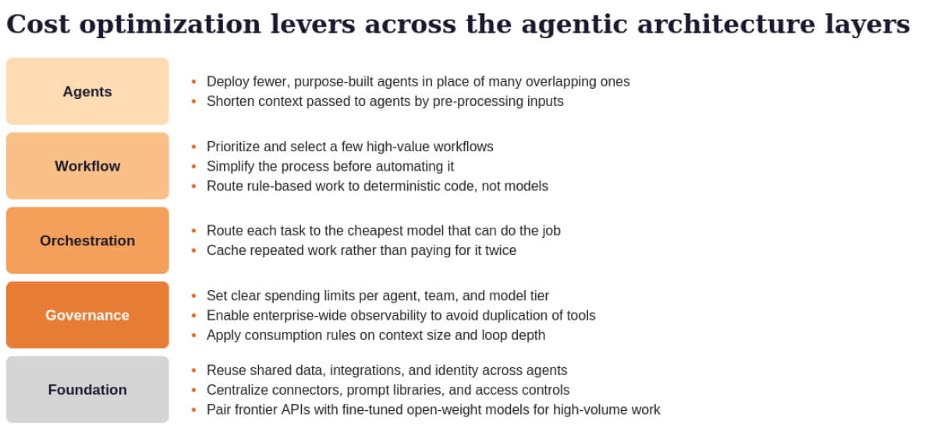
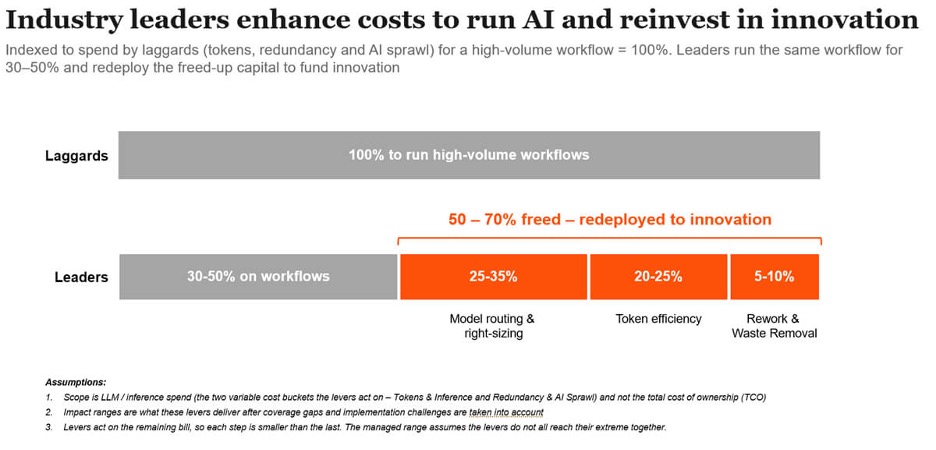
The savings come in order. Right-sizing the model and improving token efficiency deliver most of the reduction; consolidating duplicated tooling then removes AI sprawl. Controls keep the sprawl from returning: spending limits per agent, team and model tier, plus consumption rules on context size and loop depth, stop cost per outcome from drifting back up as usage scales.
In PwC’s engagements, these levers together have cut 50% to 70% from the run-rate cost of a given workflow when applied in order—budget that then funds more work rather than more waste.
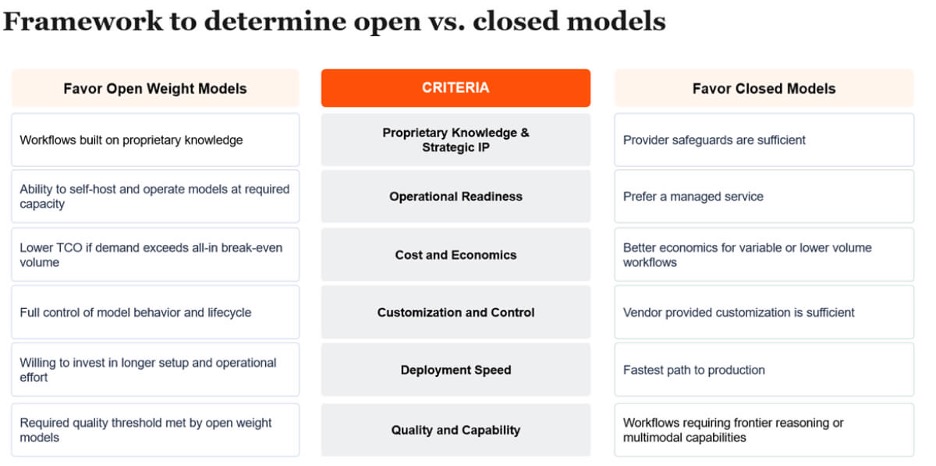
Increasingly capable open-weight models give companies a real alternative to control costs. Judged fully loaded—infrastructure, operations and engineering included—their economics tend to become more favorable at high volume. But cost isn’t the only factor. Companies should also consider how to protect and compound their institutional “alpha,” the differentiated knowledge embedded in their data, workflows and decisions, within the enterprise rather than allowing it to strengthen external platforms. The right answer isn’t an open versus closed model strategy; it’s a portfolio approach.
Conclusion
So the question each industry leader should be able to answer is simple: Do you know your cost per business outcome, and is it falling as the portfolio grows? For an executive deciding where to start, four moves matter most:
- Focus on a few high-value workflows.
- Choose the enterprise AI model that fits, weighing security, data privacy and cost.
- Fund reusable architecture, governance and controls, such as spending limits and consumption rules that improve the economics of scale.
- Judge spend by outcomes, not tokens.
In a landscape this fast-moving, no single fix will stay optimal for long. What lasts is the discipline of knowing where the money goes and redeploying it when the ground shifts. That capability, more than any single model or tool, is what the next phase of AI will reward.